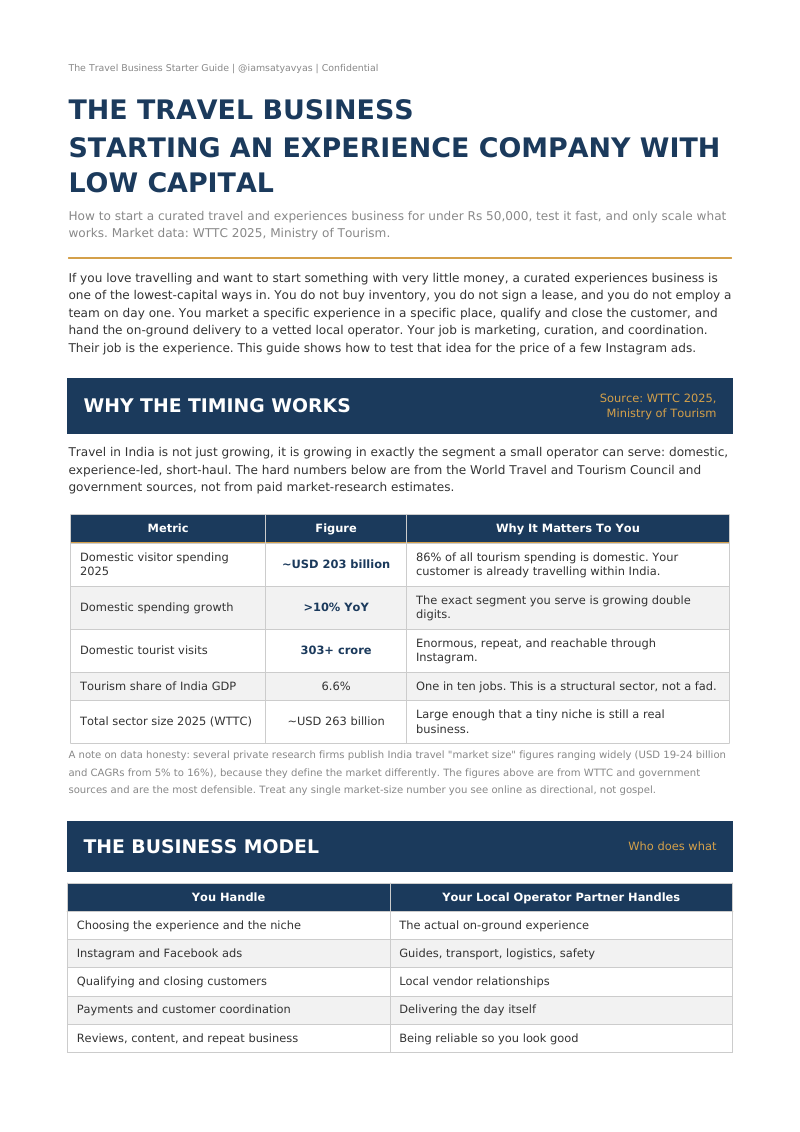
THE TRAVEL BUSINESS STARTING AN EXPERIENCE COMPANY WITH LOW CAPITAL
How to start a curated travel and experiences business for under Rs 50,000, test it fast, and only scale what works. Market data: WTTC 2025, Ministry of Tourism.
If you love travelling and want to start something with very little money, a curated experiences business is one of the lowest-capital ways in. You do not buy inventory, you do not sign a lease, and you do not employ a team on day one. You market a specific experience in a specific place, qualify and close the customer, and hand the on-ground delivery to a vetted local operator. Your job is marketing, curation, and coordination. Their job is the experience. This guide shows how to test that idea for the price of a few Instagram ads.
WHY THE TIMING WORKS
Source: WTTC 2025, Ministry of Tourism
Travel in India is not just growing, it is growing in exactly the segment a small operator can serve: domestic, experience-led, short-haul. The hard numbers below are from the World Travel and Tourism Council and government sources, not from paid market-research estimates.
| Metric | Figure | Why It Matters To You |
|---|---|---|
| Domestic visitor spending 2025 | ~USD 203 billion | 86% of all tourism spending is domestic. Your customer is already travelling within India. |
| Domestic spending growth | >10% YoY | The exact segment you serve is growing double digits. |
| Domestic tourist visits | 303+ crore | Enormous, repeat, and reachable through Instagram. |
| Tourism share of India GDP | 6.6% | One in ten jobs. This is a structural sector, not a fad. |
| Total sector size 2025 (WTTC) | ~USD 263 billion | Large enough that a tiny niche is still a real business. |
A note on data honesty: several private research firms publish India travel "market size" figures ranging widely (USD 19-24 billion and CAGRs from 5% to 16%), because they define the market differently. The figures above are from WTTC and government sources and are the most defensible. Treat any single market-size number you see online as directional, not gospel.
THE BUSINESS MODEL
Who does what
| You Handle | Your Local Operator Partner Handles |
|---|---|
| Choosing the experience and the niche | The actual on-ground experience |
| Instagram and Facebook ads | Guides, transport, logistics, safety |
| Qualifying and closing customers | Local vendor relationships |
| Payments and customer coordination | Delivering the day itself |
| Reviews, content, and repeat business | Being reliable so you look good |
The honest catch: this model has a low barrier to entry, which means it is crowded. Anyone can run ads for "Manali packages." What separates a business that works from one that burns money is a specific, hard-to-copy niche -- a particular kind of experience for a particular kind of traveller. Do not sell "trips." Sell one thing, to one person, better than anyone else. The differentiation is the whole game.
HOW TO START
Idea to first customer
Step 1 — Pick one experience, not a destination. "Sunrise trek and cafe-hopping weekend in a hill town" beats "tours of North India." A specific experience is easier to market, easier to price, and easier to make memorable.
Step 2 — Pick a high-footfall city with a unique hook. Somewhere people already want to go, with something you can make special. High existing demand means your ads work harder for less money.
Step 3 — Find and vet 1-2 local operators. Message local guides and small operators on the ground. Check reviews, do a video call, and ideally have someone experience it once. Your reputation rides entirely on their reliability.
Step 4 — Agree commercials clearly. You take a margin or a fixed coordination fee per traveller. Put it in writing: who collects payment, who refunds, what happens if plans change. Clarity here prevents every future dispute.
Step 5 — Build one simple landing point. An Instagram page and a WhatsApp number is enough to start. You do not need a website or an app to test whether people will pay.
Step 6 — Run a small ad test. Put Rs 30,000-50,000 total behind Instagram and Facebook ads for your one experience. This is your entire experiment budget, not a monthly commitment.
Step 7 — Qualify, close, coordinate. Reply fast, ask two qualifying questions (dates and group size), send the details, take the booking, and hand delivery to your operator. Collect a review the moment the trip ends.
THE EXPERIMENT
Small bet, fast read
Treat the first phase as an experiment with a fixed budget and a clear kill switch, not as "starting a company." The whole point of this model is that failure is cheap.
| Element | Guideline |
|---|---|
| Total experiment budget | Rs 30,000-50,000, all-in. This is what you can afford to lose. |
| What it buys | Instagram + Facebook ads for one experience over a few weeks. |
| What you are testing | Will strangers pay you to book this experience? Nothing else. |
| The kill switch | If ads do not convert to real bookings after the budget is spent, stop. Do not top up hoping it turns around. |
| The green light | If you get paying customers and good reviews, reinvest the profit and add a second experience or city. |
What Comes Next
This business is a starting point, not the destination. Because it needs almost no capital, it is a way to build three things at once: cash flow, a customer base in a specific city, and real on-ground knowledge of that market. Once you have saved enough from coordination margins, the natural next step is to reinvest in an asset in the same city you now understand deeply -- for many people that is a short-term rental. You will already know the demand, the seasons, the micromarkets, and the local operators. The travel business funds the education and the down payment; the asset builds the long-term wealth.
Based on research and personal experience. Please do your own research as well. Research by @iamsatyavyas | Market data: WTTC 2025, Ministry of Tourism | July 2026