Theobroma Case Study | Confidential
C A S E S T U D Y
Theobroma
How a single Colaba bakery became a Rs 2,678 crore company in 21 years
For operators and founders in food and beverage retail | August 2026 | Sources: MCA filings, Business Standard, Business Today, company disclosures
Rs 2,410 cr Rs 2,678 cr 250+ ~Rs 10.7 cr Paid for ~90% stake Implied company value Stores at 40+ cities Value per store
The short version
In October 2004, two sisters opened a four-table bakery in a converted doctor's clinic in Colaba, using Rs 1 crore from their father. In July 2025, ChrysCapital agreed to buy roughly 90 percent of it for Rs 2,410 crore, valuing the company at about Rs 2,678 crore.
The number that matters to a single-unit operator: at 250 stores, the buyer valued each Theobroma outlet at roughly Rs 10.7 crore, against annual revenue of about Rs 2.6 crore per store. Net profit in the final year was only Rs 22.5 crore, and falling. Nobody was paying for profit. They were paying for a repeatable unit.
How it started
Kainaz Messman was 24 and a pastry chef at The Oberoi Mumbai when a bulging disc ended her ability to stand in a professional kitchen. She refused a desk job.
Her mother, Kamal, had run a home-based cake business for years. Her father, Farokh, put up Rs 1 crore on one condition: it would never be repaid. Her sister, Tina Messman Wykes, returned from London to build it with her. They opened on Dussehra 2004 with four small tables, using their grandparents' flat next door as the kitchen. The break-even target was Rs 22,000 a day. They beat it in the first week. The brownie and the mawa cake, still the two largest sellers, came from their mother's recipes.
| Year | Milestone | Footprint |
|---|---|---|
| 2004 | First store opens in a converted doctor's clinic, Colaba. Rs 1 crore of family capital. | 1 store |
| 2017 | ICICI Venture invests approximately Rs 130 crore for a minority stake. | Approx. 30 stores |
| 2019-20 | Capital goes into central kitchens and supply chain, not storefronts. | Approx. 50 stores |
| FY21 | Revenue of Rs 121 crore. Bengaluru entry. Delivery is 10-20 percent of sales. | 78 stores |
| Jul 2025 | ChrysCapital agrees to buy approximately 90 percent for Rs 2,410 crore. | 194 stores, 30+ cities |
| 2026 | ChrysCapital in control. QSR-style expansion underway. | 250+ stores, 40+ cities |
What the numbers looked like
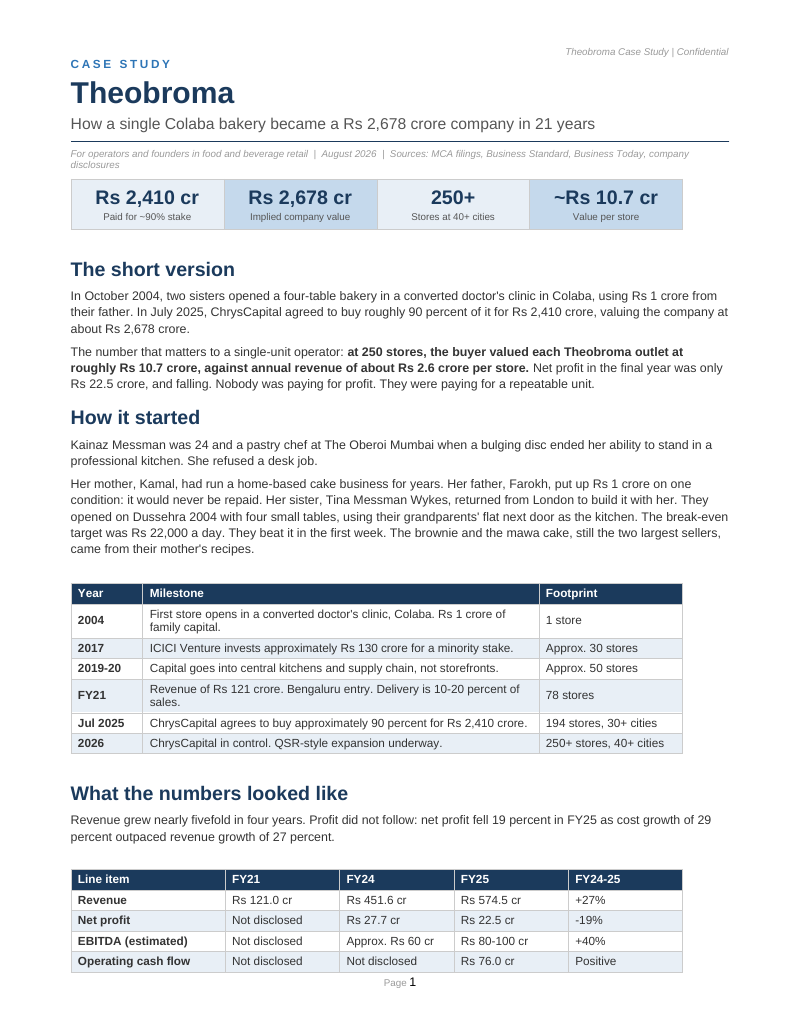
Revenue grew nearly fivefold in four years. Profit did not follow: net profit fell 19 percent in FY25 as cost growth of 29 percent outpaced revenue growth of 27 percent.
| Line item | FY21 | FY24 | FY25 | FY24-25 |
|---|---|---|---|---|
| Revenue | Rs 121.0 cr | Rs 451.6 cr | Rs 574.5 cr | +27% |
| Net profit | Not disclosed | Rs 27.7 cr | Rs 22.5 cr | -19% |
| EBITDA (estimated) | Not disclosed | Approx. Rs 60 cr | Rs 80-100 cr | +40% |
| Operating cash flow | Not disclosed | Not disclosed | Rs 76.0 cr | Positive |
Theobroma Case Study | Confidential
Margins were compressing and the company still cleared Rs 2,678 crore. Operating cash flow stayed positive at Rs 76 crore: the model funded its own expansion.
The acquisition
| Deal term | Detail |
|---|---|
| Buyer and price | ChrysCapital, an India-focused private equity firm. Rs 2,410 crore (approximately USD 275 million). |
| Stake acquired | Approximately 90 percent at announcement; the founding family retained about 10 percent |
| Implied 100 percent value | Approximately Rs 2,678 crore (enterprise value approximately USD 315 million) |
| Competing bidders | Bain Capital, Carlyle, Switz Group (owner of Monginis) |
| Valuation multiples | Approximately 4.4x FY25 revenue; approximately 24x to 30x FY25 EBITDA |
| Early investor return | ICICI Venture put in Rs 130 crore in 2017 for approximately 42 percent. Exit proceeds of approximately Rs 1,125 crore, or 8.5x in eight years. |
The per-store math
| Metric | Figure | Basis |
|---|---|---|
| Implied value of the whole company | Rs 2,678 cr | Rs 2,410 cr paid for approximately 90 percent |
| Stores today (2026) | 250+ | Value per store: approximately Rs 10.7 cr |
| Revenue per store per year | Approx. Rs 2.6 cr | FY25 revenue divided by average store count |
| Value paid per rupee of store revenue | 4x to 5x | The buyer paid four to five years of a single store's sales |
Why it was worth this much
-
They took outside capital before they needed it. Rs 130 crore arrived in 2017 at roughly 30 stores, and went into central kitchens and supply chain rather than storefronts. It bought the ability to open the next hundred stores, not the next ten.
-
They built the kitchen before the store. The rule was to get the commissary kitchen and product specs right before entering a new city. A single-unit owner optimises the store. Theobroma optimised what makes the next fifty stores possible.
-
They productised the craft. The same 2004 recipes, produced to spec at scale. A packageable product is inventory, and inventory is valuable to a buyer. Chef-dependent craft is not.
-
They were valued on the multiple, not the margin. Rs 22.5 crore of profit produced a Rs 2,410 crore cheque. Single stores are valued on what they earn. Systems are valued on what they can be copied into.
The takeaway. A Theobroma store does about Rs 2.5 crore a year. That is a good cafe, not an extraordinary one. What made each one worth Rs 10 crore is that there were 250 of them running the same playbook. The question is not whether a store is profitable. It is whether it is repeatable. Profit produces an income. Repeatability produces an exit.
Note on figures: FY24 and FY25 revenue and profit are from MCA filings. EBITDA is an estimate reported in deal coverage, not an audited disclosure. The Rs 3,000 crore figure widely circulated online was the promoters' asking price, not the transaction value. Store counts are from the company's own store locator and contemporaneous reporting.