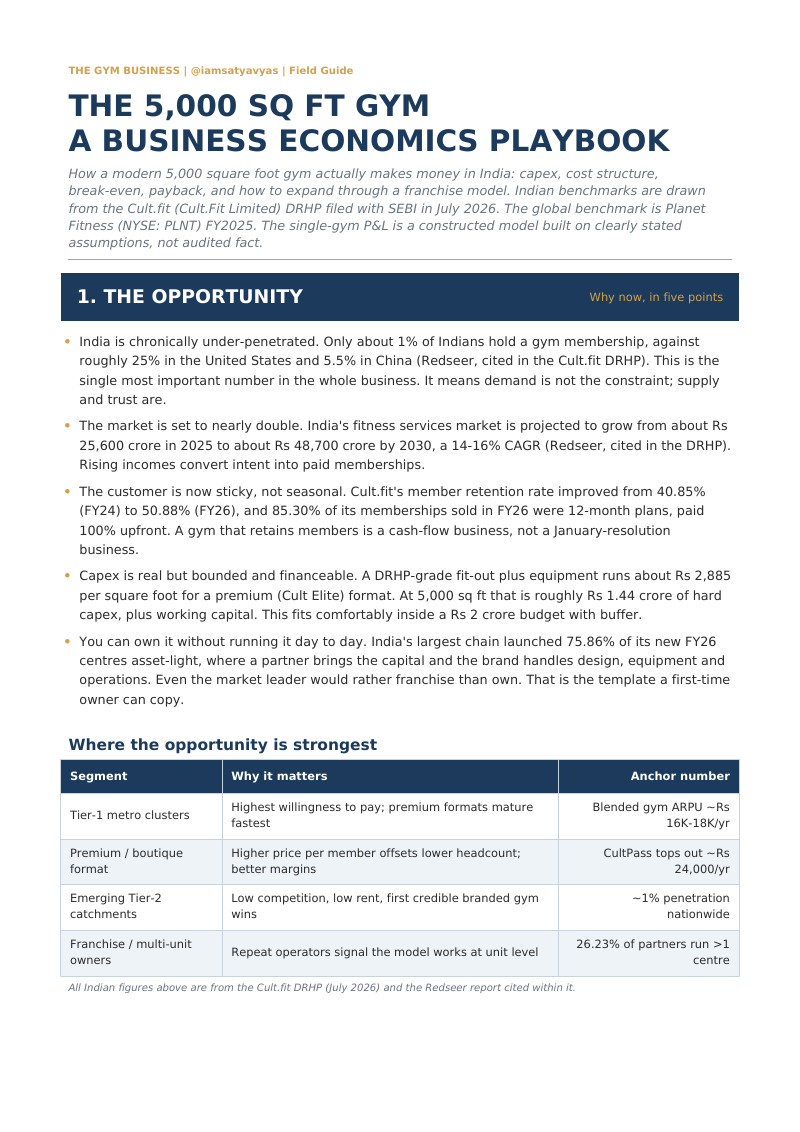
THE 5,000 SQ FT GYM A BUSINESS ECONOMICS PLAYBOOK
How a modern 5,000 square foot gym actually makes money in India: capex, cost structure, break-even, payback, and how to expand through a franchise model. Indian benchmarks are drawn from the Cult.fit (Cult.Fit Limited) DRHP filed with SEBI in July 2026. The global benchmark is Planet Fitness (NYSE: PLNT) FY2025. The single-gym P&L is a constructed model built on clearly stated assumptions, not audited fact.
1. THE OPPORTUNITY
Why now, in five points
-
India is chronically under-penetrated. Only about 1% of Indians hold a gym membership, against roughly 25% in the United States and 5.5% in China (Redseer, cited in the Cult.fit DRHP). This is the single most important number in the whole business. It means demand is not the constraint; supply and trust are.
-
The market is set to nearly double. India's fitness services market is projected to grow from about Rs 25,600 crore in 2025 to about Rs 48,700 crore by 2030, a 14-16% CAGR (Redseer, cited in the DRHP). Rising incomes convert intent into paid memberships.
-
The customer is now sticky, not seasonal. Cult.fit's member retention rate improved from 40.85% (FY24) to 50.88% (FY26), and 85.30% of its memberships sold in FY26 were 12-month plans, paid 100% upfront. A gym that retains members is a cash-flow business, not a January-resolution business.
-
Capex is real but bounded and financeable. A DRHP-grade fit-out plus equipment runs about Rs 2,885 per square foot for a premium (Cult Elite) format. At 5,000 sq ft that is roughly Rs 1.44 crore of hard capex, plus working capital. This fits comfortably inside a Rs 2 crore budget with buffer.
-
You can own it without running it day to day. India's largest chain launched 75.86% of its new FY26 centres asset-light, where a partner brings the capital and the brand handles design, equipment and operations. Even the market leader would rather franchise than own. That is the template a first-time owner can copy.
Where the opportunity is strongest
| Segment | Why it matters | Anchor number |
|---|---|---|
| Tier-1 metro clusters | Highest willingness to pay; premium formats mature fastest | Blended gym ARPU ~Rs 16K-18K/yr |
| Premium / boutique format | Higher price per member offsets lower headcount; better margins | CultPass tops out ~Rs 24,000/yr |
| Emerging Tier-2 catchments | Low competition, low rent, first credible branded gym wins | ~1% penetration nationwide |
| Franchise / multi-unit owners | Repeat operators signal the model works at unit level | 26.23% of partners run >1 centre |
All Indian figures above are from the Cult.fit DRHP (July 2026) and the Redseer report cited within it.
2. WHY THIS IS NO LONGER A The structural change BODYBUILDER'S BUSINESS
For two decades, the Indian gym was a low-trust, cash-heavy, owner-dependent business. Members paid month to month, dropped off after March, and the whole P&L lived or died on the owner standing at the front desk. Three things changed that.
| What changed | Old model | New model |
|---|---|---|
| Payment | Monthly, unpredictable, high churn | Annual, upfront, 85% on 12-month plans |
| Retention | Seasonal; collapses after January | Structurally rising: 41% to 51% in two years |
| Operations | Owner-run, no data, no standardisation | App-tracked, tooled, standardised, remotely monitored |
| Expansion | Self-funded, one gym at a time | Asset-light franchise; capital and ops separated |
The one-line version
The gym stopped being a place you run and became an asset you own. Upfront annual cash, rising retention, and remote tooling turned a founder-dependent shop into a repeatable, financeable unit. That is why a serious operator with capital should now look at it the way they would look at a Airbnb portfolio or a QSR franchise, not the way they looked at a neighbourhood gym in 2010.
DRHP-certified, scaled to 5,000 sq 3. WHAT IT COSTS TO BUILD ft
The Cult.fit DRHP publishes architect-certified, chartered-accountant-verified build costs per square foot for two formats. These are the cleanest public capex numbers available for a modern Indian gym. Below, the premium (Cult Elite) rate is scaled to a 5,000 sq ft owner-operated gym.
Certified cost per square foot (from the DRHP)
| Cost head | Cult Elite (premium) | Cult Neo (standard) |
|---|---|---|
| Civil & interior works | 665 | 491 |
| Electrical works | 456 | 337 |
| Furniture & fixtures | 80 | 80 |
| Signage & branding | 115 | 96 |
| Others (incl. HVAC) | 315 | 206 |
| Sub-total: fit-out (A) | 1,631 | 1,210 |
| Fitness equipment (B) | 1,254 | 613 |
| Total per sq ft (A+B) | 2,885 | 1,823 |
Rates in Rs per square foot. Source: Cult.fit DRHP, certified by PhygitalXP Designs Pvt Ltd (architect) and Manian & Rao, Chartered Accountants, both dated July 6, 2026.
Your build: 5,000 sq ft, premium format
| Line item | Basis | Amount (Rs) |
|---|---|---|
| Fit-out (civil, electrical, F&F, signage, HVAC) | Rs 1,631 x 5,000 sq ft | 81,55,000 |
| Fitness equipment | Rs 1,254 x 5,000 sq ft | 62,70,000 |
| Hard capex sub-total | Rs 2,885 x 5,000 sq ft | 1,44,25,000 |
| Security deposit (rent) | ~6 months at Rs 5.0L/mo | 30,00,000 |
| Pre-opening (staffing, launch marketing, working capital) | Owner estimate | 20,00,000 |
| Total investment required | All-in to open + run | 1,94,25,000 |
Fit-out and equipment rates are DRHP-certified. Deposit and pre-opening are owner planning estimates for a Tier-1 metro and must be adjusted to your actual lease and city. The point of the table: a premium 5,000 sq ft gym lands just under Rs 2 crore all-in, leaving genuine buffer inside that budget.
4. HOW THE MONEY WORKS Revenue, ARPU, and the P&L;
Gym revenue has three legs: memberships (the base), personal training (the margin), and ancillary income such as supplements, merchandise and, at scale, advertising. The DRHP confirms the blended annual gym ARPU in India at roughly Rs 16,000 to Rs 18,000. A premium format sits at the top of that band.
Constructed Year-2 (stabilised) P&L
Assumptions, stated explicitly: 5,000 sq ft premium gym, Tier-1 metro; 1,100 active paid members at a blended Rs 18,000/year; personal training at 12% of membership revenue; rent Rs 5.0L/month; a lean team of 14; year shown is a stabilised year after ramp, not year one.
| Line | Basis | Rs / year |
|---|---|---|
| Membership revenue | 1,100 members x Rs 18,000 | 1,98,00,000 |
| Personal training | 12% of membership | 23,76,000 |
| Ancillary (supplements, merch) | Owner estimate | 8,00,000 |
| Total revenue | 2,29,76,000 | |
| Rent | Rs 5.0L x 12 | (60,00,000) |
| Salaries | 14 staff, blended | (66,00,000) |
| Utilities, upkeep, AMC | Power-heavy; HVAC | (21,00,000) |
| Marketing | Steady-state | (14,00,000) |
| Other opex | Software, misc | (9,00,000) |
| Centre-level profit (pre-tax, pre-D&A) | ~26% margin | 59,76,000 |
This is a constructed planning model, not audited fact. A single private gym does not publish a P&L. Treat every input as adjustable. The margin shown (~26%) is deliberately kept in the range the DRHP reports for matured centres, not above it.
5. BREAK-EVEN AND PAYBACK
The honest timeline
This is the section most reels skip, and it is the one that protects you. A gym is a patience business. The DRHP defines a matured centre as one that has been operational for at least 24 months.
Membership ramps; it does not switch on. Plan for two years to stabilise.
| Milestone | Typical timing | What it means |
|---|---|---|
| Operational break-even | Month 10-14 | Monthly revenue covers monthly running cost |
| Centre maturity | Month 24 | Membership base and margin stabilise (DRHP definition) |
| Capex payback | ~Year 3-4 | Cumulative profit recovers the ~Rs 1.9 Cr invested |
6. WHAT CAN GO WRONG
And how to protect against it
| Risk | Why it bites | Mitigation |
|---|---|---|
| Slow ramp | Break-even needs 10-14 months; cash runs thin before then | Fund 18 months of runway; pre-sell hard before opening |
| Wrong site | A gym cannot be moved; a bad catchment is permanent | Over-invest in Weeks 1-4; use real footfall, not instinct |
| Rent creep | Rent is the largest fixed cost after payroll | Cap escalation in the lease; keep rent under ~28% of revenue |
| Trainer churn | Members follow trainers; the trainer is the product | Pay well, retain your best; the DRHP shows training is the single largest people cost for a reason |
| Discount spiral | Price wars destroy margin and signal weakness | Compete on experience and retention, not on price |
The bottom line
The gym business changed underneath everyone. Upfront annual cash, retention climbing past 50%, and remote tooling turned a founder-dependent shop into a real, ownable, financeable asset. The capex is bounded: a premium 5,000 sq ft gym lands just under Rs 2 crore all-in. The economics are honest: roughly two years to mature. This is a patience business with real upside for operators who pick the site well, pre-sell before they open, and give it time.
The market is not the constraint. At 1% penetration heading toward a doubling by 2030, demand is waiting. The constraint is execution. If you have the capital and the patience, this is one of the clearest brick-and-mortar bets in India right now.
Research by @iamsatyavyas | Indian figures from the Cult.fit (Cult.Fit Limited) DRHP filed with SEBI, July 2026, and the Redseer report cited within it | Global benchmark from Planet Fitness (NYSE: PLNT) FY2025 filings | The single-gym P&L is a constructed planning model built on stated assumptions, not audited fact | This is analysis, not investment advice | July 2026