FITNESS BUSINESS PLAYBOOK
Business Research & Plan
Can your passion for fitness replace your salary? Five fitness and wellness businesses to test alongside a day job, without the capital a full-scale gym requires.
Data: Deloitte India / Health & Fitness Association, MarkNtel Advisors, Expert Market Research, Grand View Research, FSSAI and Indian industry pricing sources (listed on the last page). USD converted at USD 1 = Rs 96. India 2026 | October 2026 | Confidential
1. Executive Summary
The Opportunity in 5 Points
-
A full gym is the wrong first bet. A 3,000 sq ft mid-premium or premium gym needs roughly Rs 1.05-1.20 crore at a planning allowance of Rs 3,500-4,000 per sq ft. That is not a universal Bangalore rate. Each model below launches on Rs 0.5-10 lakh.
-
The market is growing and under-penetrated. Commercial fitness grows from Rs 16,200 crore (2024) to Rs 37,700 crore (2030), a 15% CAGR. Only 0.8% of Indians hold a facility membership and about 820 million adults aged 18-62 are inactive [1].
-
The gap is the narrow offer, not the new gym. Value gyms such as Anytime and Crunch dominate, while boutique formats grow fastest at 18.8% a year [1]. Each model sells one thing to one audience: coaching clients, class members, retreat seats or a single product.
-
Margin and scale trade off. Illustrative operating profit runs from Rs 12.6 lakh a year for online coaching (52.5% margin) to Rs 4.3 lakh for niche athleisure (12.0%). Services earn higher margins. Products carry stock and returns.
-
The test is time-boxed. A 90-day test with pre-sold customers decides whether to continue, based on repeat customers, referrals and positive contribution after direct costs, not turnover.
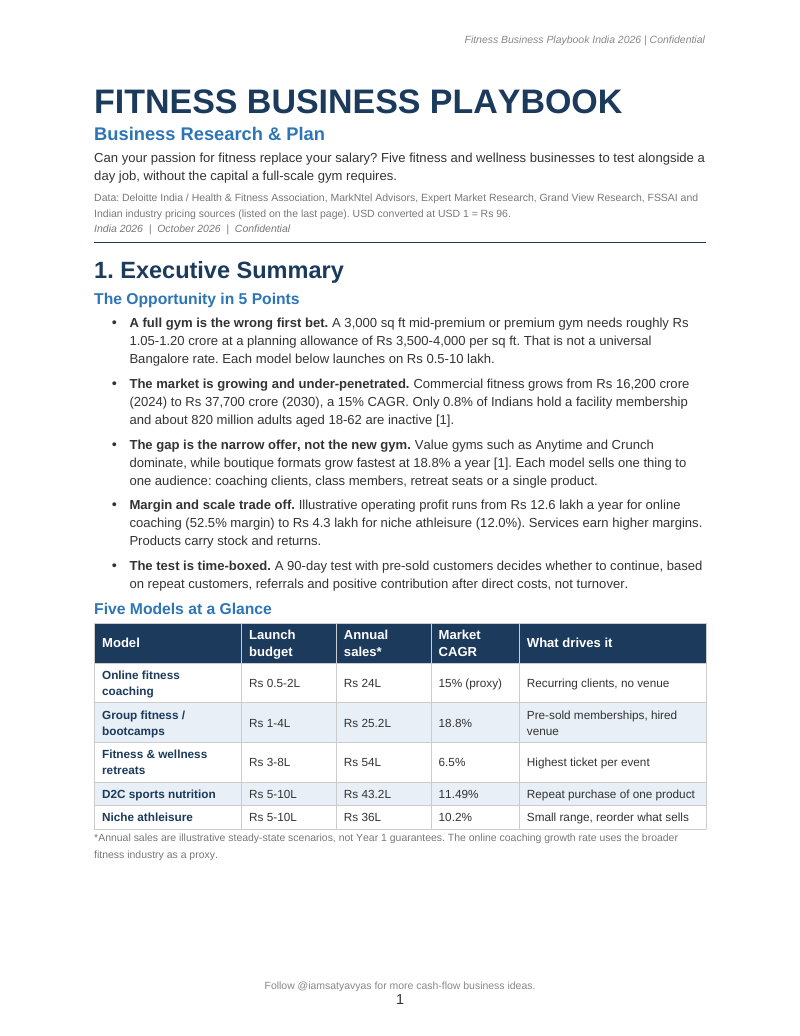
Five Models at a Glance
| Model | Launch budget | Annual sales* | Market CAGR | What drives it |
|---|---|---|---|---|
| Online fitness coaching | Rs 0.5-2L | Rs 24L | 15% (proxy) | Recurring clients, no venue |
| Group fitness / bootcamps | Rs 1-4L | Rs 25.2L | 18.8% | Pre-sold memberships, hired venue |
| Fitness & wellness retreats | Rs 3-8L | Rs 54L | 6.5% | Highest ticket per event |
| D2C sports nutrition | Rs 5-10L | Rs 43.2L | 11.49% | Repeat purchase of one product |
| Niche athleisure | Rs 5-10L | Rs 36L | 10.2% | Small range, reorder what sells |
*Annual sales are illustrative steady-state scenarios, not Year 1 guarantees. The online coaching growth rate uses the broader fitness industry as a proxy.
2. Market Landscape
| Segment | Base and forecast | CAGR | Source |
|---|---|---|---|
| Commercial fitness, all formats | Rs 16,200 crore (2024) to Rs 37,700 crore (2030) | 15% | Deloitte/HFA [1] |
| Boutique fitness (yoga, HIIT, MMA, Pilates) | Fastest-growing facility segment | 18.8% to 2030 | Deloitte/HFA [1] |
| Fitness memberships | 12.3 million (2024) to 23.2 million (2030). Penetration 0.8% to 1.7% | n/a | Deloitte/HFA [1] |
| Sports nutrition | USD 363 million (2024) to USD 706 million (2030). About Rs 3,485 crore to Rs 6,778 crore | 11.49% | MarkNtel [2] |
| Wellness tourism | USD 21.23 billion (2024) to USD 39.85 billion (2034). About Rs 2.04 lakh crore to Rs 3.83 lakh crore | 6.5% | Expert Market Research [3] |
| Gym apparel | Growth rate only. Size estimates vary widely by publisher and are not used here | 10.2% (2025-30) | Grand View Research [4] |
What This Means for the Five Models
The five models sit in segments growing between 6.5% and 18.8% a year. Boutique fitness, where group classes sit, grows fastest. Wellness tourism, where retreats sit, grows slowest. The top ten cities generate more than half of fitness revenue with under a third of facilities [1], so start in your home city. These are category forecasts, not growth targets for a new business.
3. Competitive White Space
| Segment | Who serves it | Intensity | Opportunity |
|---|---|---|---|
| Gyms (value and full-service) | Anytime, Crunch and branded chains [1] | High | Scale and capital game. A 3,000 sq ft gym needs Rs 1.05-1.20 crore. |
| Boutique and group formats | Independent studios: HIIT, yoga, MMA, Pilates [1] | Medium | Hire hours, pre-sell memberships, skip the lease. |
| Online coaching | Independent coaches and platforms | Medium to high | Low barrier. Win with one defined audience. |
| Retreats | Resorts and retreat operators | Medium | Curate with a resort and a coach. No property. |
| Nutrition and apparel products | Established national brands | High | One hero product. Test demand before widening. |
The gap. Large chains are built for volume and fixed locations. A founder testing alongside a job can sell one programme, class, retreat or product to a specific audience at low fixed cost, then scale only what retains customers.
Target customer. Working professionals in metros who pay for structure and accountability. Genuine 1-on-1 online coaching in India costs Rs 3,000-8,000 a month against Rs 8,000-18,000 for in-person training [6]. Smaller cities, women and lower-income households are the named growth pockets [1].
4. The Five Models
01 Online fitness coaching
Rs 0.5-2 lakh to start
What you sell. A defined coaching programme for a clear audience, for example strength training for working professionals. Start with a handful of paying clients and simple tracking tools. Add coaching support only when demand justifies it.
Launch and economics. Coaching software costs about USD 19-140 a month (Rs 1,800-13,400) depending on clients and add-ons [10].
Monthly: 40 clients x Rs 5,000 = Rs 2.00 lakh. Less coaching support and software 0.45, marketing and sales 0.35, admin and payment costs 0.15. Operating profit Rs 1.05 lakh.
Annual: revenue Rs 24 lakh, operating profit Rs 12.6 lakh (52.5%).
Evidence and watch-outs. Rs 5,000 a month sits inside the Rs 3,000-8,000 Indian price band for genuine 1-on-1 online coaching [6]. Growth uses the 15% fitness proxy [1]. Watch client retention and your own weekly workload. Suits a day job if client calls and delivery can be scheduled.
02 Group fitness / bootcamps
Rs 1-4 lakh to start
What you sell. Strength, mobility or conditioning classes in a studio hired by the hour or an approved community space. Pre-sell memberships before booking regular sessions. A dependable coach makes the format easier to run around office hours.
Launch and economics. Existing gyms and studios commonly rent off-peak hours to independent instructors at Rs 500-2,000 an hour [7].
Monthly: 60 members x Rs 3,500 = Rs 2.10 lakh. Less coach fees and venue 0.95, marketing and administration 0.40. Operating profit Rs 0.75 lakh.
Annual: revenue Rs 25.2 lakh, operating profit Rs 9 lakh (35.7%).
Evidence and watch-outs. Boutique fitness is the fastest-growing segment at 18.8% a year [1]. Boutique customers in Tier 1 and 2 cities pay Rs 4,000-8,000 a month [7], so Rs 3,500 sits at the low end. Watch attendance, renewals, coach availability and permissions.
03 Fitness & wellness retreats
Rs 3-8 lakh to test
What you sell. A two-or three-day experience built with a resort and an established coach. Confirm the minimum viable guest count and supplier cancellation terms before taking non-refundable commitments.
Launch and economics. Per retreat: 12 guests x Rs 75,000 = Rs 9.00 lakh. Less resort, food, experts and logistics 5.40, acquisition and coordination 1.80. Operating profit Rs 1.80 lakh (20%).
Annual: six sold-out retreats give Rs 54 lakh revenue and Rs 10.8 lakh operating profit.
Evidence and watch-outs. Wellness tourism grows 6.5% a year [3]. Typical Indian weekend retreats (2 nights) are priced at Rs 8,000-18,000 a person and 7-day immersions at Rs 25,000-75,000 [8]. Rs 75,000 for a weekend is a premium-tier price against this range. Revenue is uneven across the year; delivery dates and vendor advances need careful planning.
04 D2C sports nutrition
Rs 5-10 lakh to start
What you sell. One product for a specific buyer with a clear reason to purchase, such as hydration mixes or convenient protein formats. Get quotations, test the landed cost and confirm repeat demand before widening the range.
Launch and economics. Possible budget: Rs 3-5 lakh for stock, Rs 1-2 lakh for product testing and design, the balance for marketing and cash reserves.
Monthly: 300 orders x Rs 1,200 = Rs 3.60 lakh. Less product, packaging and shipping 1.62, advertising and selling commissions 0.90, returns, platform and overhead 0.55. Operating profit Rs 0.53 lakh.
Annual: revenue Rs 43.2 lakh, operating profit about Rs 6.4 lakh (14.7%).
Evidence and watch-outs. India sports nutrition grows 11.49% a year, from USD 363 million to USD 706 million by 2030, and supplements hold over 70% of it [2]. Confirm FSSAI licensing for yourself and your contract manufacturer; advisers state a Central licence applies to nutraceutical manufacturers, importers and marketers regardless of turnover [5]. Watch gross margin after shipping, cost per customer and second-purchase rate. Return-to-origin runs 25-35% in India at Rs 150-300 an order [9].
05 Niche athleisure
Rs 5-10 lakh to start
What you sell. One category you understand: training tees, running essentials or women's strength-training apparel. Launch a small range, get fit feedback and reorder only the sizes and styles that sell.
Launch and economics. Possible budget: Rs 3-5 lakh initial stock, Rs 1 lakh sampling and content, Rs 1-2 lakh each for marketing and working capital. Some Tiruppur activewear makers quote 250-300 pieces minimum per style and colour [12].
Monthly: 250 orders x Rs 1,200 = Rs 3.00 lakh. Less garments, packaging and shipping 1.44, advertising and creator promotions 0.75, returns, software and overhead 0.45. Operating profit Rs 0.36 lakh.
Annual: revenue Rs 36 lakh, operating profit about Rs 4.3 lakh (12.0%).
Evidence and watch-outs. India gym apparel grows 10.2% a year through 2030 [4]. Shopify stores cost Rs 2,000-6,000 a month; shipping aggregators include Shiprocket, Delhivery and Eshipz [11]. Watch sell-through by size, returns, gross margin and inventory ageing.
5. Customer Acquisition
| Channel | How it works | Expected output |
|---|---|---|
| Instagram content | Short videos and posts for one audience, with a WhatsApp call to action. | Steady enquiries. High effort, better leads, builds over weeks. |
| Paid ads (Instagram, Facebook) | Click-to-WhatsApp or lead-form ads for a pilot offer. | Faster volume, lower-quality leads. Track cost per customer. |
| Referrals and founding offers | Early clients and members refer friends for founding pricing. | Low cost. The clearest signal the offer works. |
| Community and partner tie-ups | Societies, office groups, resorts or coaches promote class and retreat pre-sales. | Cohorts of buyers at a shared margin. Needs permissions. |
| Creators and commissions | Creators and affiliates promote the product for a commission. | Product orders. Track returns and cost per order. |
6. Financial Model
| Illustrative annual P&L (Rs lakh) | Sales | Costs | Profit | Operating margin |
|---|---|---|---|---|
| Online coaching | 24.0 | 11.4 | 12.6 | 52.5% |
| Group fitness | 25.2 | 16.2 | 9.0 | 35.7% |
| Retreats | 54.0 | 43.2 | 10.8 | 20.0% |
| Sports nutrition | 43.2 | 36.8 | 6.4 | 14.7% |
| Athleisure | 36.0 | 31.7 | 4.3 | 12.0% |
-
Steady-state scenarios, not Year 1. Profit is operating profit before tax, financing, depreciation and a founder salary, not take-home pay. Coaching assumes the founder still delivers some work.
-
Funding: launch budgets of Rs 0.5-10 lakh can come from savings and salary. Pre-sold memberships, retreat deposits and first orders fund delivery. The 90-day test needs no outside capital.
7. Getting Started: The 90-Day Test
| Days | Step | What to do |
|---|---|---|
| 1-15 | Pick one audience | Speak to 20 potential customers. Understand their spending habits, alternatives and what they would actually pay for. |
| 16-30 | Sell a pilot | Secure paid coaching clients, founding class members, retreat deposits or initial product orders. |
| 31-60 | Deliver | Track customer feedback, delivery cost, retention, refunds and the real cost of winning each customer. |
| 61-90 | Decide | Continue only if customers return, referrals emerge and contribution after direct costs is positive. |
When to leave your job. Only after repeatable demand, positive cash flow and runway for slower months. Compare sustainable owner income after tax and reinvestment with your salary, not turnover.
8. Risk Factors
| Risk | Impact | Mitigation |
|---|---|---|
| Churn and coach availability | Revenue below break-even. Cancelled sessions. | Track retention monthly. Pre-sell. A coach plus a backup. Written venue approval. |
| Retreat cash flow | Vendor advances paid before guests pay. Uneven revenue. | Confirm minimum guest count and cancellation terms. Collect deposits first. |
| Licensing and landed cost (nutrition) | Margin erosion. Regulatory exposure. | Test landed cost first. Confirm FSSAI licence, permitted claims and label rules. |
| Returns and inventory (products) | Return-to-origin 25-35%, Rs 150-300 an order [9]. Unsold sizes. | Small first batch. Reorder only what sells. Prefer prepaid orders. |
| Day-job conflict | Missed calls, late delivery. | Deliver outside work hours. Outsource fulfilment. Stop if the job is at risk. |
Closing Note
India's fitness market is set to more than double by 2030 while facility membership penetration sits at 0.8% [1]. The category is early, and the entry cost for a narrow offer is a fraction of a gym lease.
Start with one offer and one audience. Add a second only after retention, referrals and contribution margin hold for the first. Services scale through repeat clients and members. Products scale through repeat purchase and sell-through.
Pick one model, speak to 20 potential customers this month, and sell the pilot before you spend on stock, venues or software. Follow @iamsatyavyas for more cash-flow business ideas.
Visual Summary
| Figure | What it is |
|---|---|
| Rs 37,700 cr | India fitness market by 2030, 15% CAGR [1] |
| Rs 1.05-1.20 cr | Planning allowance for a 3,000 sq ft mid-premium or premium gym |
| Rs 0.5-10 lakh | Launch budget range for the five models |
The gap: a narrow offer for one audience, sold before capital is committed.
Illustrative annual operating profit (Rs lakh)
- Online coaching Rs 12.6L | 52.5%
- Retreats Rs 10.8L | 20.0%
- Group fitness Rs 9.0L | 35.7%
- Sports nutrition Rs 6.4L | 14.7%
- Athleisure Rs 4.3L | 12.0%
The 90-day journey
| Days 1-15 | Days 16-30 | Days 31-60 | Days 61-90 |
|---|---|---|---|
| Pick one audience | Sell a pilot | Deliver | Decide |
Key takeaways
-
Customers first, capital second. Pre-sell before booking venues or ordering stock.
-
Services earn 20-52.5% margins. Products earn 12-15% and carry stock and returns.
-
Continue only when customers return, referrals appear and contribution is positive.
Sources. [1] Deloitte India and Health & Fitness Association, India Fitness Market Report 2025. [2] MarkNtel Advisors, India Sports Nutrition Market 2025-30. [3] Expert Market Research, India Wellness Tourism Market. [4] Grand View Research, India Gym Apparel Outlook 2025-30. [5] FSSAI licensing and registration; adviser summaries of the Health Supplements and Nutraceuticals Regulations (Biofril Healthcare, Seyecs, 2026). [6] YourTrainer.in, online versus in-person trainer costs in India, 2026. [7] MyGymDesk, gym revenue streams and pricing guide. [8] IIFL, yoga and wellness retreat business guide. [9] Razorpay, cost to launch a D2C brand in India 2026, citing Shiprocket and IBEF. [10] FitBudd and Assistant Coach, coaching software pricing, 2026. [11] eCommFusion, D2C launch checklist India 2026. [12] Mass India, Tiruppur activewear minimum order quantities. Market-size estimates for the same category vary by publisher; each figure here follows the source cited against it. FX: USD 1 = Rs 96.
Disclaimer. This report is for education and general information only. It is not investment advice. Do your own research and consult your financial advisor before investing or starting a business. Market forecasts and financial projections are estimates and may differ materially from actual results.