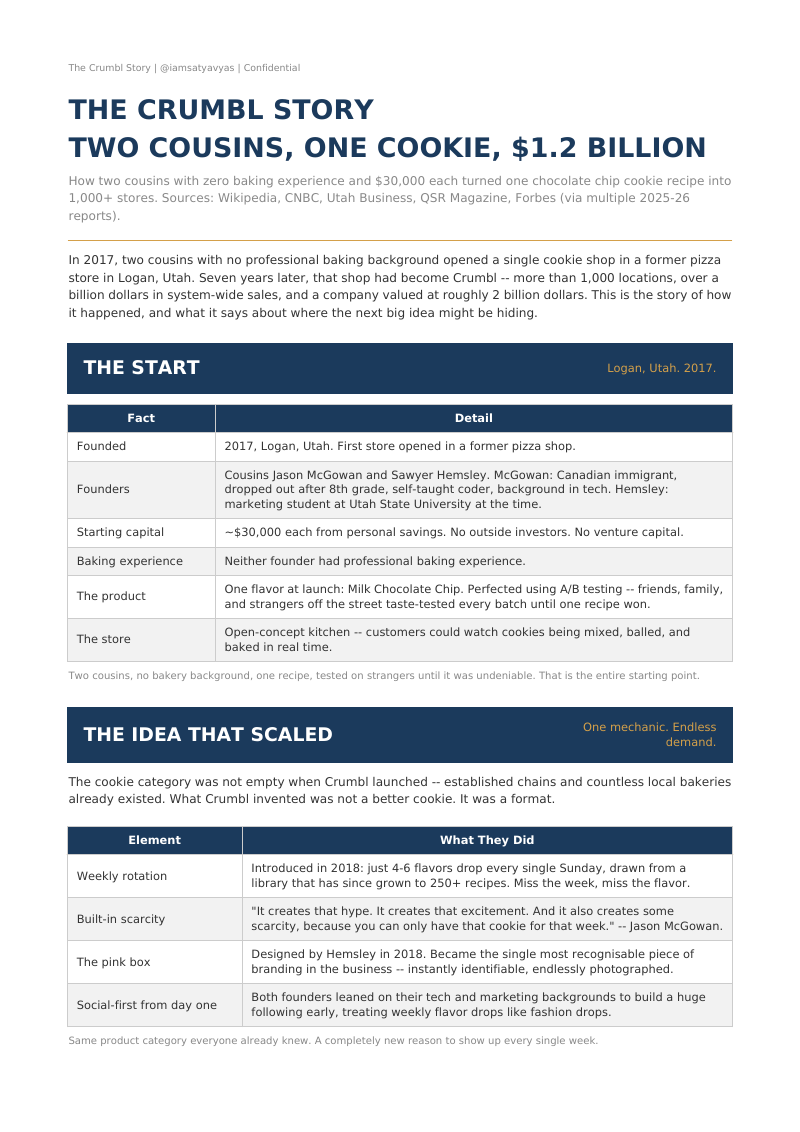
THE CRUMBL STORY TWO COUSINS, ONE COOKIE, $1.2 BILLION
How two cousins with zero baking experience and $30,000 each turned one chocolate chip cookie recipe into 1,000+ stores. Sources: Wikipedia, CNBC, Utah Business, QSR Magazine, Forbes (via multiple 2025-26 reports).
In 2017, two cousins with no professional baking background opened a single cookie shop in a former pizza store in Logan, Utah. Seven years later, that shop had become Crumbl -- more than 1,000 locations, over a billion dollars in system-wide sales, and a company valued at roughly 2 billion dollars. This is the story of how it happened, and what it says about where the next big idea might be hiding.
THE START
Logan, Utah. 2017.
| Fact | Detail |
|---|---|
| Founded | 2017, Logan, Utah. First store opened in a former pizza shop. |
| Founders | Cousins Jason McGowan and Sawyer Hemsley. McGowan: Canadian immigrant, dropped out after 8th grade, self-taught coder, background in tech. Hemsley: marketing student at Utah State University at the time. |
| Starting capital | ~$30,000 each from personal savings. No outside investors. No venture capital. |
| Baking experience | Neither founder had professional baking experience. |
| The product | One flavor at launch: Milk Chocolate Chip. Perfected using A/B testing -- friends, family, and strangers off the street taste-tested every batch until one recipe won. |
| The store | Open-concept kitchen -- customers could watch cookies being mixed, balled, and baked in real time. |
Two cousins, no bakery background, one recipe, tested on strangers until it was undeniable. That is the entire starting point.
THE IDEA THAT SCALED
One mechanic. Endless demand.
The cookie category was not empty when Crumbl launched -- established chains and countless local bakeries already existed. What Crumbl invented was not a better cookie. It was a format.
| Element | What They Did |
|---|---|
| Weekly rotation | Introduced in 2018: just 4-6 flavors drop every single Sunday, drawn from a library that has since grown to 250+ recipes. Miss the week, miss the flavor. |
| Built-in scarcity | "It creates that hype. It creates that excitement. And it also creates some scarcity, because you can only have that cookie for that week." -- Jason McGowan. |
| The pink box | Designed by Hemsley in 2018. Became the single most recognisable piece of branding in the business -- instantly identifiable, endlessly photographed. |
| Social-first from day one | Both founders leaned on their tech and marketing backgrounds to build a huge following early, treating weekly flavor drops like fashion drops. |
Same product category everyone already knew. A completely new reason to show up every single week.
From one store to a national brand
THE SCALE
| Milestone | Detail |
|---|---|
| First franchise | 2018 -- opened by Sawyer Hemsley's own parents. |
| By 2020 | 90 locations. |
| By end of 2024 | 1,059 stores across all 50 US states, plus Canada and Puerto Rico. |
| System-wide sales, 2024 | Crossed $1.2 billion. |
| App ranking | Crumbl's app ranked among the Top 10 Food & Drink apps in the US -- ahead of Domino's, Taco Bell, and Chipotle. Remarkable for a company selling one product category. |
| Social following | Multiple millions of followers across Instagram and TikTok, built almost entirely through the weekly flavor-drop mechanic. |
| 2025 valuation | Crumbl reached a reported valuation of roughly $2 billion. Eight years after two cousins put in $30,000 each to open one store. |
The Takeaway
No bakery background. No investors. No unique ingredient nobody else had access to. Two cousins picked one product, obsessed over getting it right, and built one simple mechanic -- a weekly reason to come back -- that turned a crowded, ordinary category into a billion-dollar brand. The ingredients were always available to anyone. The idea was the only thing that was scarce.
Based on research and personal experience. Please do your own research as well.
Research by @iamsatyavyas | Sources: Wikipedia, CNBC, Utah Business, QSR Magazine, 2025-26 reporting | July 2026