Bangkok café business case study
INSIDE BANGKOK'S CAFÉ ECONOMY
Eight dessert, bakery and beverage brands decoded through revenue, store scale, ownership and the operating ideas Indian founders should notice.
Research by @iamsatyavyas | Published September 2026 | Thailand data unless stated otherwise
Bangkok's strongest café and dessert brands combine one memorable product with a format that can scale beyond a full restaurant. Four of these eight examples already have meaningful revenue or store-count proof; the others show how luxury, culinary authority and automation can create powerful differentiation.
| Figure | What it is |
|---|---|
| ₹450 cr | After You 2025 sales, converted from THB 1.616bn |
| 250 | Approx. Yoguruto outlets reported in 2026 |
| ₹82 cr | Oh! Juice sales over a reported nine months |
| 2,200 | Approx. Gong Cha locations globally |
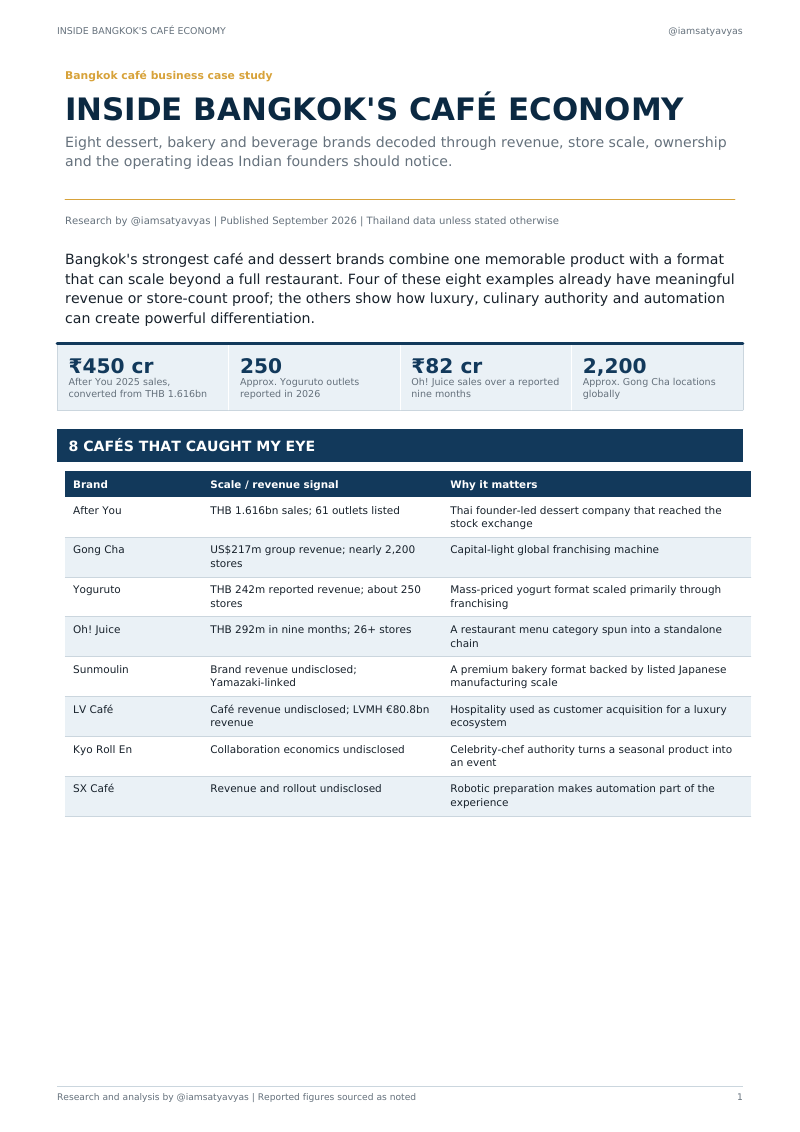
8 CAFÉS THAT CAUGHT MY EYE
| Brand | Scale / revenue signal | Why it matters |
|---|---|---|
| After You | THB 1.616bn sales; 61 outlets listed | Thai founder-led dessert company that reached the stock exchange |
| Gong Cha | US$217m group revenue; nearly 2,200 stores | Capital-light global franchising machine |
| Yoguruto | THB 242m reported revenue; about 250 stores | Mass-priced yogurt format scaled primarily through franchising |
| Oh! Juice | THB 292m in nine months; 26+ stores | A restaurant menu category spun into a standalone chain |
| Sunmoulin | Brand revenue undisclosed; Yamazaki-linked | A premium bakery format backed by listed Japanese manufacturing scale |
| LV Café | Café revenue undisclosed; LVMH €80.8bn revenue | Hospitality used as customer acquisition for a luxury ecosystem |
| Kyo Roll En | Collaboration economics undisclosed | Celebrity-chef authority turns a seasonal product into an event |
| SX Café | Revenue and rollout undisclosed | Robotic preparation makes automation part of the experience |
FOUR PROVEN SCALE STORIES
Where the numbers support the narrative
|Brand|The business story|The transferable lesson| |After You|Gulapat ‘May’ Kanokwatanawan opened the first café in 2007 after publishing dessert cookbooks. Shibuya Honey Toast became the hero product. The listed company reported THB 1.616bn in 2025 sales and THB 204m net profit; its site currently lists 61 After You branches.|A dessert can become a destination when the product is distinctive enough to drive a specific visit. The real asset is repeatable product memory—not menu breadth.| |Gong Cha|Founded in Taiwan in 2006, Gong Cha has nearly 2,200 locations across 33 markets. It reported US$217m in 2025 group revenue and more than US$70m EBITDA. Thailand is operated through master franchisee Perfect Step, which reportedly agreed to build more than 100 stores.|Standardisation, supply-chain control and master franchising can scale faster than a company-owned café network.| |Yoguruto|The Thai yogurt-smoothie concept started during COVID near a university despite doubts that customers would buy the category frequently. Reported revenue rose from THB 1.5m in 2021 to THB 242m in 2025; recent coverage cites about 250 stores and more than 10m cups sold.|Affordable pricing and a simple production system can take a niche ‘healthy’ product into the mass market. The network is the larger proof point than the still-sub-₹80 crore reported revenue.| |Oh! Juice|Listed restaurant operator OKJ turned juices from its Ohkajhu menu into a standalone functional-smoothie brand in May 2024. By December 2025 it had 26+ stores and reported THB 292m in accumulated nine-month sales.|Before inventing a new concept, extract a proven product category from an existing customer base. A smaller beverage format can expand faster than the parent restaurant.|
The strongest operating insight: After You built scale around indulgence; Yoguruto around affordability; Oh! Juice around wellness; and Gong Cha around standardisation. The category matters less than having one proposition customers can repeat in a sentence.
FOUR ATTENTION-LED CONCEPTS
| Brand | Why it caught attention | Commercial interpretation |
|---|---|---|
| Sunmoulin | The Bangkok bakery is associated with the Yamazaki group, the listed Japanese baker founded in 1948. Fresh production, a broad display and visible queues create powerful retail theatre. Standalone Thai brand revenue is not public. | The queue itself reduces purchase anxiety. But the difficult-to-see advantage is manufacturing and procurement capability—not merely the storefront or product display. |
| LV Café | LV The Place Bangkok combines an exhibition, store, café and restaurant by Gaggan Anand. Parent LVMH reported €80.8bn revenue in 2025, but café revenue is not disclosed. | The café should be read as experiential retail, not necessarily a standalone café-growth strategy. Food increases dwell time, accessibility and social sharing around a high-ticket luxury brand. |
| Kyo Roll En mooncakes | Thai dessert entrepreneur Dej Kewkacha collaborated with Hideaki Sato of Hong Kong's three-Michelin-star Ta Vie on a premium mooncake collection. Michelin stars belong to Ta Vie—not to the mooncakes. | A limited seasonal product can command attention by borrowing credible creative authority. The collaboration creates urgency and premium perception without building a new permanent format. |
| SX Café | At QSNCC, robotic preparation turns the production process into the attraction. Public revenue and rollout data are unavailable. | Automation can improve consistency and attract trial, but machinery is not a moat by itself. The test is whether throughput, uptime and labour savings compensate for equipment and maintenance costs. |
The deeper advantage: The strongest concepts compress the brand into one clear reason to visit—a hero dessert, yogurt smoothie, functional juice, luxury experience or automated service. That clarity makes customer recall, premium pricing and expansion easier.
WHAT INDIAN FOUNDERS SHOULD TAKE AWAY
For aspiring café and bakery owners, the takeaway is simple: build one product people remember, a format your team can reproduce, and store economics that support repeatable expansion.
-
Lead with one product people can name. After You has Shibuya Honey Toast; yogurt smoothies define Yoguruto; functional smoothies define Oh! Juice. A hero product concentrates demand and marketing memory.
-
Design the format around expansion. Gong Cha and Yoguruto can occupy smaller footprints with narrower production systems than full cafés. Lower complexity makes franchising and site replication easier.
-
Choose a deliberate price position. Yoguruto built mass reach through affordability, while Oh! Juice uses functional ingredients to justify a premium. Price, product and audience must reinforce one another.
-
Make production visible when it improves trust. Fresh baking, thick smoothie preparation or a robot barista can function as content. Operational theatre is useful only when the underlying product still drives repeat purchase.
-
Choose the correct growth engine. Company-owned stores maximise control; franchising accelerates reach; a spin-off leverages an existing customer base; luxury hospitality supports a larger brand rather than store-level economics.
-
Do not confuse attention with a business moat. Queues, collaborations and Instagram-friendly presentation can create the first transaction. Repeat rate, gross margin, store throughput and payback determine whether the format deserves to scale.
THE ONE-LINE FILTER
Before opening another café
Can a customer explain your hero product, target occasion and reason to choose you in one sentence—and can the store reproduce that promise without founder supervision? If either answer is no, more décor or a larger menu will not solve the business.
SOURCES
After You Investor Relations; After You company history; TNN Thailand, After You FY2025; Reuters, Gong Cha, May 2026; Bain Capital, Gong Cha scale; Forbes Thailand, Yoguruto; OKJ Group, Oh! Juice; Thairath Money, Oh! Juice; Gaysorn Village, LV The Place; Louis Vuitton Thailand; LVMH results; Kyo Roll En collaboration; QSNCC.