After You Dessert Cafe - Bangkok case study
HOW AFTER YOU BUILT A DESSERT BRAND AROUND ONE HERO PRODUCT
The origin, numbers and broad learnings for aspiring Indian home bakers and small bakery businesses.
Research by @iamsatyavyas | Published September 2026 | Company data through June 2026
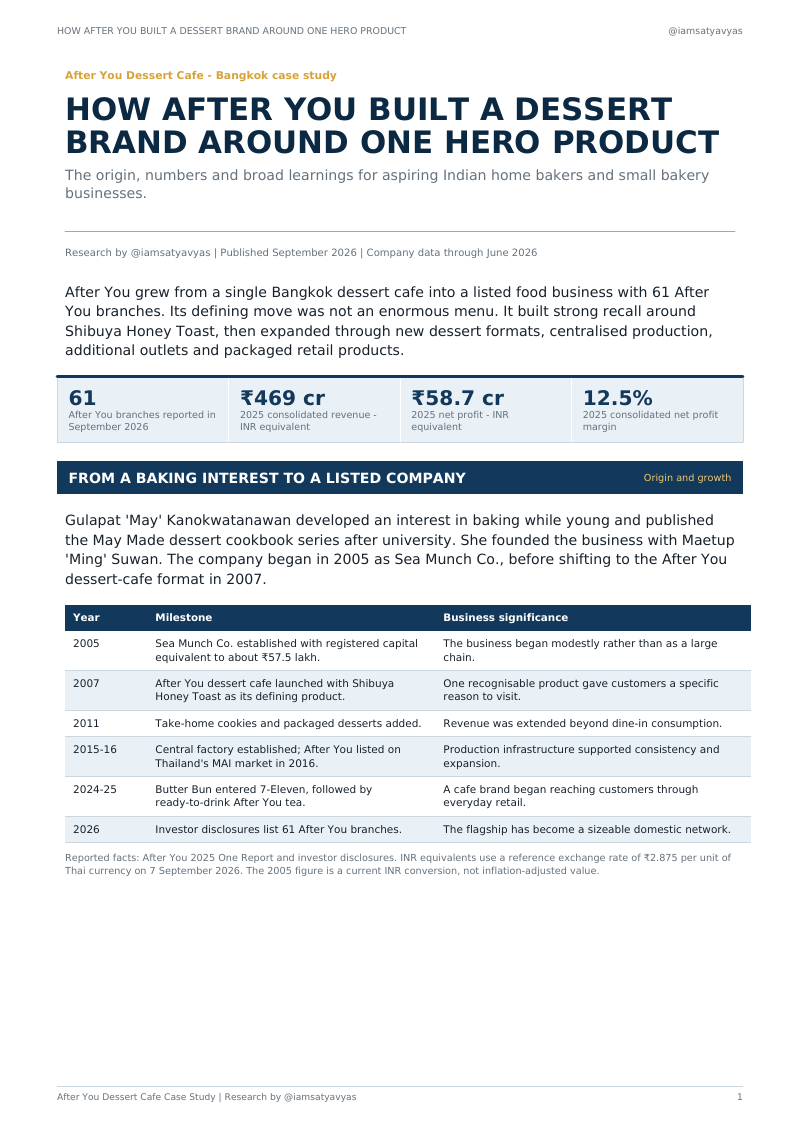
After You grew from a single Bangkok dessert cafe into a listed food business with 61 After You branches. Its defining move was not an enormous menu. It built strong recall around Shibuya Honey Toast, then expanded through new dessert formats, centralised production, additional outlets and packaged retail products.
| Figure | What it is |
|---|---|
| 61 | After You branches reported in September 2026 |
| ₹469 cr | 2025 consolidated revenue, INR equivalent |
| ₹58.7 cr | 2025 net profit, INR equivalent |
| 12.5% | 2025 consolidated net profit margin |
FROM A BAKING INTEREST TO A LISTED COMPANY
Origin and growth
FROM A BAKING INTEREST TO A LISTED COMPANY
Gulapat 'May' Kanokwatanawan developed an interest in baking while young and published the May Made dessert cookbook series after university. She founded the business with Maetup 'Ming' Suwan. The company began in 2005 as Sea Munch Co., before shifting to the After You dessert-cafe format in 2007.
| Year | Milestone | Business significance |
|---|---|---|
| 2005 | Sea Munch Co. established with registered capital equivalent to about ₹57.5 lakh. | The business began modestly rather than as a large chain. |
| 2007 | After You dessert cafe launched with Shibuya Honey Toast as its defining product. | One recognisable product gave customers a specific reason to visit. |
| 2011 | Take-home cookies and packaged desserts added. | Revenue was extended beyond dine-in consumption. |
| 2015-16 | Central factory established; After You listed on Thailand's MAI market in 2016. | Production infrastructure supported consistency and expansion. |
| 2024-25 | Butter Bun entered 7-Eleven, followed by ready-to-drink After You tea. | A cafe brand began reaching customers through everyday retail. |
| 2026 | Investor disclosures list 61 After You branches. | The flagship has become a sizeable domestic network. |
Reported facts: After You 2025 One Report and investor disclosures. INR equivalents use a reference exchange rate of ₹2.875 per unit of Thai currency on 7 September 2026. The 2005 figure is a current INR conversion, not inflation-adjusted value.
THE NUMBERS BEHIND THE BRAND
Reported company performance
| Period | Revenue in INR | Net profit in INR | Net margin |
|---|---|---|---|
| 2023 | ₹354.7 cr | ₹51.2 cr | 14.4% |
| 2024 | ₹460.9 cr | ₹85.2 cr | 18.5% |
| 2025 | ₹469.3 cr | ₹58.7 cr | 12.5% |
| First half 2026 | ₹236.2 cr | ₹25.8 cr | 10.9% |
Revenue and profit are consolidated figures converted into INR using one September 2026 reference rate for readability. They are not revenue from 61 After You cafes alone. The group also earns from goods and raw materials, OEM production, catering and other brands. Historical exchange rates would produce different INR values.
HOW ONE PRODUCT BECAME A PLATFORM
The growth mechanism
| Growth layer | What After You did | Why it mattered |
|---|---|---|
| Clear memory | Made Shibuya Honey Toast the brand's signature. | Customers could associate the business with a specific experience. |
| Product theatre | Used warm toast, melting ice cream, tall shaved ice and molten centres. | Texture and presentation made the visit easy to share and discuss. |
| Format expansion | Added kakigori, warm desserts, beverages and take-home products. | The menu broadened without losing the original product identity. |
| Operational control | Invested in factories, distribution and employee training. | Standardised inputs helped maintain consistency across branches. |
| Visible locations | Expanded through premium malls and high-footfall destinations. | Queues became public evidence of demand and reinforced awareness. |
| Retail reach | Moved buns and beverages into convenience stores. | Purchase occasions extended beyond a planned cafe visit. |
THE FLAGSHIP MENU ARCHITECTURE
Publicly featured products
| Product | Role in the portfolio |
|---|---|
| Shibuya Honey Toast | The original signature and strongest shorthand for the brand |
| Thai Tea Kakigori | A dramatic shaved-ice format carrying a recognisable Thai flavour |
| Mango Sticky Rice Kakigori | A seasonal product linking the brand to a familiar local dessert |
| Strawberry Cheesecake Kakigori | A globally familiar flavour presented through After You's format |
| Chocolate Lava Cake and Panookie | Warm, indulgent alternatives built around texture and reveal |
| Butter Bun | A simpler take-home product capable of reaching retail channels |
After You publicly identifies Shibuya Honey Toast, Chocolate Lava Cake and Panookie as signature desserts. Company disclosures also feature kakigori and Butter Bun. Item-level sales are not disclosed, so this is a flagship-product view rather than an audited sales ranking.
WHAT INDIAN HOME BAKERS CAN LEARN
Broad case-study lessons
The relevant lesson is not that every baker needs a cafe or a version of honey toast. It is that a small food business becomes easier to remember and scale when product identity, repeatability and distribution develop in the right order.
| Learning | What it means for an emerging bakery |
|---|---|
| Earn recall before variety | One product should explain why the brand deserves attention. A large menu can dilute that memory. |
| Build variations around a stable base | New flavours can create novelty while ingredients, process and training remain manageable. |
| Design for conversation | Taste must lead, but texture, serving ritual and presentation increase organic discovery. |
| Separate celebration from frequency | Large cakes bring occasion-led revenue; smaller everyday desserts create more reasons to return. |
| Document the process early | Recipe cards, portion control and preparation standards make quality less dependent on the founder. |
| Let demand lead expansion | Production capacity, outlets and retail distribution should follow proven products rather than precede them. |
INDIA: A LARGE MARKET, BUT NOT A SHORTCUT
Context, not a demand forecast
| Figure | What it is |
|---|---|
| ₹5.69L cr | India food-service sector in FY2024 - NRAI |
| 8.1% | Projected food-service CAGR, 2024-28 |
| 13.2% | Projected organised-sector CAGR, 2024-28 |
| ₹1.42L cr | Broad 2025 bakery-market estimate - approximate INR |
India's food-service market is large and the organised segment is expected to grow faster than the overall sector. However, the broad bakery estimate includes bread, biscuits and other mass categories. It should not be treated as the addressable market for premium home-baked desserts. For a small bakery, local repeat orders and the share of sales coming from its defining product are more useful signals than national market size.
THE CASE STUDY IN ONE LINE
Conclusion
After You shows how a distinctive hero product can create the first wave of demand, but lasting scale comes from turning that product recognition into a repeatable operating system and progressively wider distribution.
Sources: After You PCL 2025 One Report and company history, https:/